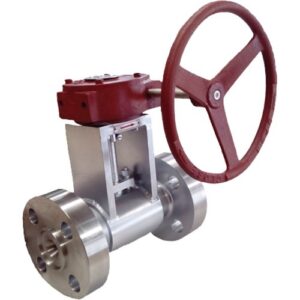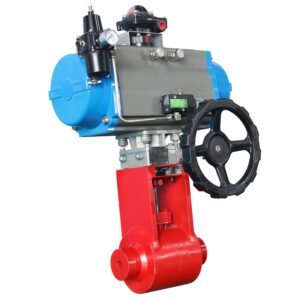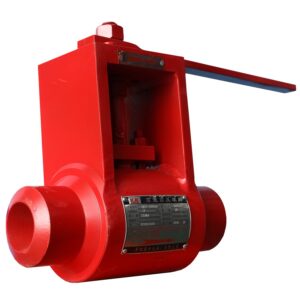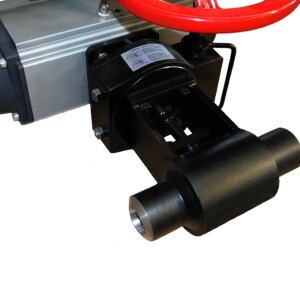
High Pressure Electric Actuated Ball Valve
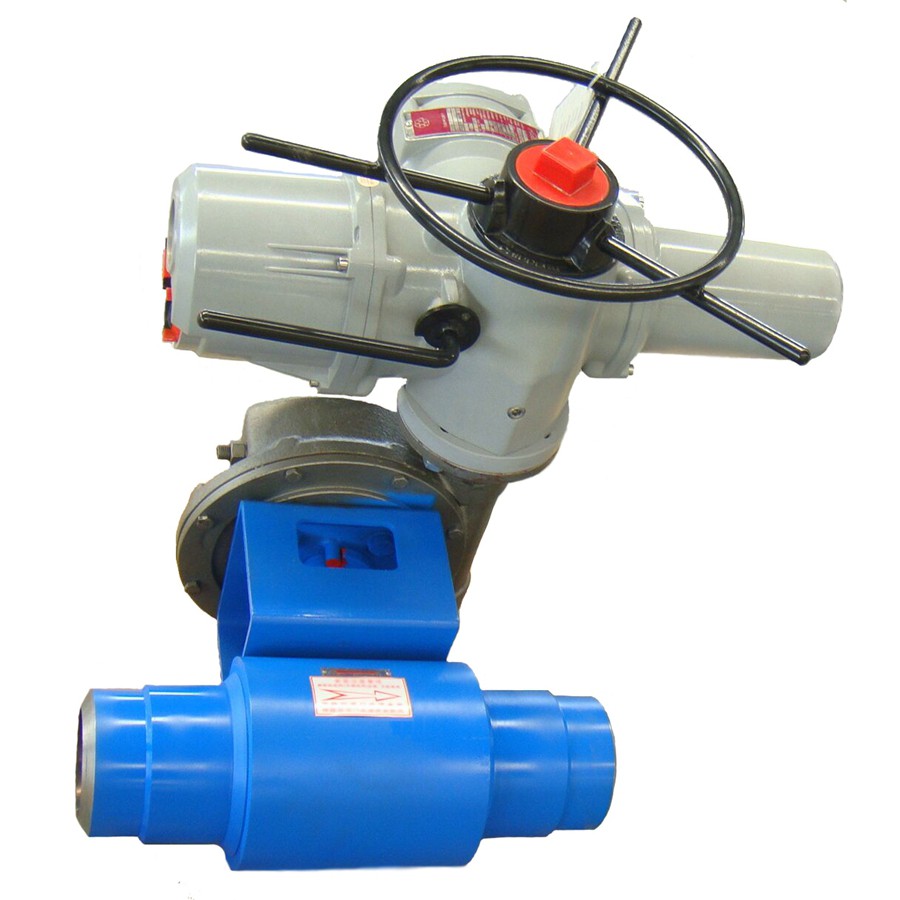
The high pressure electric actuated ball valve is composed of an electric actuator and a ball valve. High pressure electric actuated ball valve is also called motorized ball valves, motor operated ball valve or electrically operated ball valve. It is a pipeline component for industrial automation pr
Product Introduction
What is a High pressure electric actuated ball valve?
The high pressure electric actuated ball valve is composed of an electric actuator and a ball valve. High pressure electric actuated ball valve is also called motorized ball valves, motor operated ball valve or electrically operated ball valve. It is a pipeline component for industrial automation process control, usually used for remote opening and closing (connecting and cutting off medium) control of pipeline medium. The electric ball valve standard GB/T21465-2008 “Valve Terminology” is defined as: a valve whose opening and closing part (ball) is driven by the valve stem and rotates around the axis of the valve stem. It is mainly used to cut off or connect the medium in the pipeline, and it can also be used for the regulation and control of the fluid. Among them, there is a strong shear between the V-shaped ball core of the hard-sealed V-type ball valve and the metal valve seat of hard-facing carbide. Shearing force, especially suitable for media containing fibers and tiny solid particles. Electric ball valves are divided into electric flange ball valves, electric wafer ball valves, electric welding ball valves, and electric threaded ball valves. According to the sealing form, it is also divided into soft seal electric ball valve and hard seal electric ball valve.
High pressure electric actuated ball valve types are
Floating ball valve, fixed ball valve, track ball valve, V-type ball valve, three-way ball valve, stainless steel ball valve, forged steel ball valve, ash unloading ball valve, anti-sulfur ball valve, three-way ball valve, pneumatic ball valve, electric ball valve, ferrule ball valve, welded ball valve , Flanged ball valve, threaded ball valve.
Floating ball: The ball of the ball valve is floating. Under the action of medium pressure, the ball can produce a certain displacement and press tightly on the sealing surface of the outlet end to ensure the seal of the outlet end. The floating ball valve has a simple structure and good sealing performance, but the ball bears all the load of the working medium and is transmitted to the outlet sealing ring. Therefore, it is necessary to consider whether the material of the sealing ring can withstand the working load of the ball medium. , the sphere may be offset. This structure is generally used for medium and low pressure ball valves.
Fixed ball: The ball of the ball valve is fixed and does not move after being pressed. Fixed ball and ball valves are equipped with floating valve seats. After being subjected to medium pressure, the valve seat moves, so that the sealing ring is pressed tightly on the ball to ensure the sealing. Usually, bearings are installed on the upper and lower shafts with the ball, and the operating torque is small, which is suitable for high pressure and large diameter valves. In order to reduce the operating torque of the ball valve and increase the reliability of the seal, lubricating oil is used to form an oil film, which not only enhances the seal, but also reduces the operating torque, and is more suitable for high-pressure and large-diameter ball valves.
Elastic ball: The ball of the ball valve is elastic. Both the ball and the sealing ring of the valve seat are made of metal materials, and the sealing specific pressure is very high. The pressure of the medium itself cannot meet the sealing requirements, and an external force must be applied. This valve is suitable for high temperature and high pressure medium. The elastic sphere obtains elasticity by opening an elastic groove at the lower end of the inner wall of the sphere. When closing the channel, use the wedge-shaped head of the valve stem to expand the ball and press the valve seat to achieve sealing. Before turning the ball first release wedge-shaped head, and the ball along with restoration of the original prototype, so that small gap, sealing surface can reduce friction and operating torque between the ball and valve seat.
Advantages of high pressure electric actuated ball valve:
The high pressure electric actuated ball valve has a simple structure, consisting of only a few parts, saving material consumption; small size, light weight, small installation size, small driving torque, easy and quick operation, and can be quickly opened and closed by only rotating 90°; Moreover, it also has good flow regulation function and sealing characteristics. In the application fields of large and medium diameters and medium and low pressures, electric ball valves are the leading valve form. The structure principle of the electric ball valve is especially suitable for the manufacture of large diameter valves. Electric ball valves are not only widely used in general industries such as petroleum, gas, chemical industry, and water treatment, but also used in the cooling water system of thermal power plants.
Commonly used high pressure electric actuated ball valves include wafer type electric ball valves and flange type electric ball valves. The wafer type electric ball valve uses stud bolts to connect the valve between the two pipe flanges. The flange type electric ball valve has flanges on the valve, and the two flanges on the valve are connected to the pipe flanges with bolts. The strength performance of the valve refers to the ability of the valve to withstand the pressure of the medium. The valve is a mechanical product subjected to internal pressure, so it must have sufficient strength and rigidity to ensure long-term use without cracking or deformation.
High pressure electric actuated ball valve range of use
High pressure electric actuated ball valve has been widely used in petroleum, natural gas, medicine, food, hydropower, nuclear power, electric power, water supply and drainage, heating, metallurgy and other industries, and is suitable for water, solvent, acid, air, steam, gas , Petroleum and petrochemical products, corrosive media and natural gas and other general working media, but also suitable for media with harsh working conditions, such as oxygen, hydrogen peroxide, methane and ethylene, etc., are vital mechanical products for national defense construction. It is also an indispensable product for scientific and technological construction. It occupies a lot of market share, mainly because electric ball valves have strong functions, small size, reliable performance, large flow capacity, and remote control. High pressure electric actuated ball valves are not only throttling, cut-off, cut-off, Good product for diversion and the valve of choice in flow regulating systems. It has many characteristics such as pressure resistance, temperature resistance, corrosion resistance, small flow resistance, long service life and wide application range.
The main features of high pressure electric actuated ball valve are
The structure is compact, the seal is reliable, the structure is simple, and the maintenance is convenient. The sealing surface and the spherical surface are always in a closed state, which is not easy to be eroded by the medium, and is easy to operate and maintain. The ball valve body can be integral or combined.
High pressure electric actuated ball valve working principle
High pressure electric actuated ball valve has the action of rotating 90 degrees. The cock body is a sphere with a circular through hole or channel passing through its axis. The ball valve is mainly used to cut off, distribute and change the flow direction of the medium in the pipeline. It only needs to be rotated 90 degrees and a small rotational torque can be closed tightly. Ball valves are most suitable for on-off and shut-off valves.
The electric actuator inputs a standard signal of 0-10 mA, and the motor unit drives the torque of the gear and worm gear to switch and adjust the valve. Its use is mainly generated by the amount of current and regulation operation.
Selection of high pressure electric actuated ball valve
Commonly used electric actuators include rotary, single-rotary, intelligent, quarter-turn actuators, straight-stroke electric actuators, explosion-proof actuators, fine and small actuators, etc. Ball valves mainly include floating ball valves, fixed ball valves, O-type ball valves, V-type ball valves, and three-way ball valves. Combining different types of electric actuators and ball valves can produce diversified products. It is also possible to add a control box to it as a remote operation, and at the same time add other accessories to the actuator to achieve more functional applications, such as adding an electrical positioner for flow adjustment, and a resistance/current valve position converter can be used to control the valve. Position opening indication and control, the handwheel mechanism can be manually operated when there is no current, and other commonly used accessories include insulating sleeves, explosion-proof travel switches, etc. The initial selection can be made according to the working conditions.
For specific configuration, please consult our sales and look forward to your consultation.
Product Overview - XURI Valve
This Electric actuated ball valve provides reliable shut-off and flow control. Available in carbon steel, stainless steel. Class 150-2500, sizes 1"-48". API 6D certified. Fire-safe design available. Suitable for pipeline, oil & gas, chemical, and general industrial applications.
Factory direct ball valve manufacturer, API 6D fire-safe certified. OEM/ODM available for custom end connections. ISO 9001 certified, fast global shipping.
Product Features
The high pressure electric actuated ball valve has a simple structure, consisting of only a few parts, saving material consumption; small size, light weight, small installation size, small driving torque, easy and quick operation, and can be quickly opened and closed by only rotating 90°; Moreover, it also has good flow regulation function and sealing characteristics. In the application fields of large and medium diameters and medium and low pressures, electric ball valves are the leading valve form. The structure principle of the electric ball valve is especially suitable for the manufacture of large diameter valves. Electric ball valves are not only widely used in general industries such as petroleum, gas, chemical industry, and water treatment, but also used in the cooling water system of thermal power plants. Commonly used high pressure electric actuated ball valves include wafer type electric ball valves and flange type electric ball valves. The wafer type electric ball valve uses stud bolts to connect the valve between the two pipe flanges. The flange type electric ball valve has flanges on the valve, and the two flanges on the valve are connected to the pipe flanges with bolts. The strength performance of the valve refers to the ability of the valve to withstand the pressure of the medium. The valve is a mechanical product subjected to internal pressure, so it must have sufficient strength and rigidity to ensure long-term use without cracking or deformation. The structure is compact, the seal is reliable, the structure is simple, and the maintenance is convenient. The sealing surface and the spherical surface are always in a closed state, which is not easy to be eroded by the medium, and is easy to operate and maintain. The ball valve body can be integral or combined.
Available Configurations
- Sizes: DN15 - DN200 (1/2" - 8")
- Pressure Ratings: Class 150 - Class 2500 (PN16 - PN420)
- Body Materials: WCB, WCC, LCB, LCC, WC6, WC9, C5, C12A, CF8, CF8M, CF3, CF3M
- End Connections: Flanged (RF, RTJ), Butt Weld (BW), Socket Weld (SW), Threaded (NPT)
- Operation: Manual, Pneumatic, Electric, Hydraulic
- Ball Type: Floating Ball, Trunnion Mounted Ball
- Seat Design: Soft Seated (PTFE, RTFE, PEEK), Metal Seated (Stellite, Tungsten Carbide)
- Standards: API 6D, ASME B16.34, ISO 17292, API 607 (Fire Safe)
Specifications
| 压力等级 (Pressure Rating) | PN16 ~ PN420 / Class 150 ~ 2500 |
|---|---|
| 阀体材质 (Body Material) | Carbon & Alloy Steel (WCB, WC6, WC9, A105, F91, F92) |
| 适用介质 (Applicable Media) | Water, Oil, Gas, Steam |
| 连接方式 (End Connection) | Flanged / Threaded / Welded / Wafer |
| 驱动方式 (Operation Type) | Gear / Pneumatic / Electric |
| 应用领域 (Applications) | petroleum, gas, chemical industry |